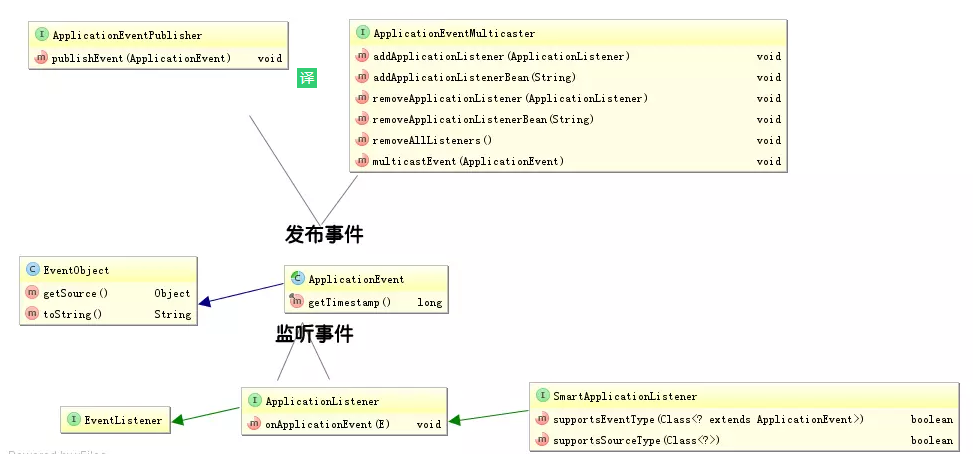
/** * Class to be extended by all application events. Abstract as it * doesn't make sense for generic events to be published directly. * * @author Rod Johnson * @author Juergen Hoeller */ publicabstractclassApplicationEventextendsEventObject {
/** use serialVersionUID from Spring 1.2 for interoperability */ privatestaticfinallongserialVersionUID=7099057708183571937L;
/** System time when the event happened */ privatefinallong timestamp;
/** * Create a new ApplicationEvent. * @param source the object on which the event initially occurred (never {@code null}) */ publicApplicationEvent(Object source) { super(source); this.timestamp = System.currentTimeMillis(); }
/** * Return the system time in milliseconds when the event happened. */ publicfinallonggetTimestamp() { returnthis.timestamp; }
/** * Notify all <strong>matching</strong> listeners registered with this * application of an application event. Events may be framework events * (such as RequestHandledEvent) or application-specific events. * @param event the event to publish * @see org.springframework.web.context.support.RequestHandledEvent */ voidpublishEvent(ApplicationEvent event);
/** * Notify all <strong>matching</strong> listeners registered with this * application of an event. * <p>If the specified {@code event} is not an {@link ApplicationEvent}, * it is wrapped in a {@link PayloadApplicationEvent}. * @param event the event to publish * @since 4.2 * @see PayloadApplicationEvent */ voidpublishEvent(Object event);
protectedvoidpublishEvent(Object event, ResolvableType eventType) { Assert.notNull(event, "Event must not be null"); if (logger.isTraceEnabled()) { logger.trace("Publishing event in " + getDisplayName() + ": " + event); }
// Decorate event as an ApplicationEvent if necessary ApplicationEvent applicationEvent; if (event instanceof ApplicationEvent) { applicationEvent = (ApplicationEvent) event; } else { applicationEvent = newPayloadApplicationEvent<Object>(this, event); if (eventType == null) { eventType = ((PayloadApplicationEvent)applicationEvent).getResolvableType(); } }
// Multicast right now if possible - or lazily once the multicaster is initialized if (this.earlyApplicationEvents != null) { this.earlyApplicationEvents.add(applicationEvent); } else { getApplicationEventMulticaster().multicastEvent(applicationEvent, eventType); }
// Publish event via parent context as well... if (this.parent != null) { if (this.parent instanceof AbstractApplicationContext) { ((AbstractApplicationContext) this.parent).publishEvent(event, eventType); } else { this.parent.publishEvent(event); } } }
/** * Interface to be implemented by application event listeners. * Based on the standard {@code java.util.EventListener} interface * for the Observer design pattern. * * <p>As of Spring 3.0, an ApplicationListener can generically declare the event type * that it is interested in. When registered with a Spring ApplicationContext, events * will be filtered accordingly, with the listener getting invoked for matching event * objects only. * * @author Rod Johnson * @author Juergen Hoeller * @param <E> the specific ApplicationEvent subclass to listen to * @see org.springframework.context.event.ApplicationEventMulticaster */ publicinterfaceApplicationListener<E extendsApplicationEvent> extendsEventListener {
/** * Handle an application event. * @param event the event to respond to */ voidonApplicationEvent(E event);

 wechat
 alipay